The Building Blocks of Interior Design
Updated: Aug 31
Design your rooms around how you want to feel when you’re in them.

This post may contain affiliate links. If you purchase through these links, I may earn a small commission at no additional cost to you. I only recommend what I truly use and love.
Style Is Helpful—But It’s Not the Point
Putting a style label on your decorating preferences is helpful when decorating your home and trying to navigate the tsunami of furniture and décor options out there.
“Style” helps you narrow your shopping choices and helps salespeople guide you to options that best fit your design sensibility.
But, if you design your home based only on style, you’ll end up with a space that looks good but feels flat.
Why?
Style is just a piece of a much bigger system composed of many design elements that make you feel the way you want to feel at home—safe, relaxed, energized, comfortable, and at ease.
Where Your Design Preferences Come From
Most of us didn’t consciously choose our taste.
We inherited it.
The homes you grew up in trained your eye. For me, that meant dark wood furniture, lots of beiges and browns, traditional jacquard upholstery, formal lamps with heavy silk shades.
The interiors I lived in in my formative years were traditional, elegant, muted spaces that changed little over time. They were pleasant and harmonious but didn’t evoke much of a reaction from me.
It never occurred to me that a room’s interior could evoke feelings in me, or anyone—until I visited Fallingwater, one of the most famous homes in modern architecture.
The Moment It Clicked: The Building Blocks of Interior Design
Before we talk about the building blocks of interior design, it helps to look at one of the most famous examples of design working exactly as it should.
That example is Fallingwater, designed by Frank Lloyd Wright, who revolutionized 20th-century architecture by designing buildings that lived in harmony with humanity and the natural environment.

My fifth grade class went on a school-sponsored field trip to Fallingwater, Frank Lloyd Wright’s iconic creation, which was designed as a weekend retreat for the Kaufmann family.
The tour started at the house’s unassuming entrance on the ground floor, through a narrow, low hallway, up a flight of stairs to the great room, an open plan living space that formed the heart of the home.
When I arrived at the top of the stairs and entered the great room, the hair on the back of my neck stood up. I instinctively knew that, whatever “genius” was, this room personified it.
The fireplace was built upon living rock. The color in the artwork, furniture, and fireplace was simultaneously vibrant and mellow. The light streamed in from a wall of windows, illuminating the room.
That room made me feel simultaneously joyful and peaceful. I wanted to stay there forever.
I had no idea that a home’s interior had the capacity to make me feel, and I wanted to know how it was done so I could do it for myself.
I stood in that incredible room with my classmates while our tour guide dutifully went through the standard spiel.
Listening to it, I realized that the feeling that room evoked in me was no accident. Frank Lloyd Wright deliberately used specific interior design elements to evoke the feeling he wanted people to have while in that space.
Great design isn’t accidental.
It’s deliberately built using specific elements.
Those elements are the building blocks of interior design. Designers aren't born seeing these things—they learn to recognize them.
And anyone can use them to create the home of their dreams.
The Seven Elements of Interior Design that Shape Every Room
Space—Why Rooms Feel Calm (or Frenetic)

Space is the room’s physical area and the positive and negative spaces that exist within that room. Positive space is occupied by a thing, like a sofa or chair; negative space is unoccupied/empty.
People don’t interpret space as “positive” or “negative”, though. Think instead about the feelings that space can evoke—from “I feel cramped” to “this room feels empty”.
A room that makes good use of space gives people places to land that feel natural and comfortable.
Line—When Your Eye Knows Where to Look

Line is the “visual path” that guides the eye through a space. We perceive line in many ways—in a curved sofa back, a pattern in flooring or wall treatments, or the architecture of a space, including coffered ceilings, crown molding, and window or door trim.
Good design leads your eye through a space without effort or confusion.
Form—The Design Backbone

Form is simply the shape of the objects in a space—curved, angular, organic, or man-made.
Form is one of the elements that give a room its personality. Curved forms make a room feel organic, relaxed, even playful. Angular forms make a room feel structured.
Light—The Most Underrated Element

Light is one of the most underrated elements of interior design. All by itself, lighting can instantly change how a room feels.
Light highlights a room’s form, color, and line and defines ambiance and function.
Color—The Emotional Driver

Color is the emotional driver in a room. It can make us feel energized, calm, playful, and even spiritual.
Color can also influence our perception of a room’s overall size and aesthetic.
Texture—Meant to be Seen and Felt

Pattern—Creating Personality, Rhythm, and Movement

Pattern—the decorative design of an item, like wallpaper, fabric, an area rug, even a stone floor—introduces visual interest and communicates personality. Too much pattern makes a room feel chaotic. Too little pattern makes a room feel bland.
Repeating pattern elements in a room or home makes the space more cohesive.
Why the Elements Matter Much More Than Style
Well-designed rooms succeed when these design elements are used together.
Utilizing them, you can create a home that supports and celebrates how you want to live and feel.
Here’s an example.
This neutral living room is transformed with the addition of form, light, color, texture, and pattern.
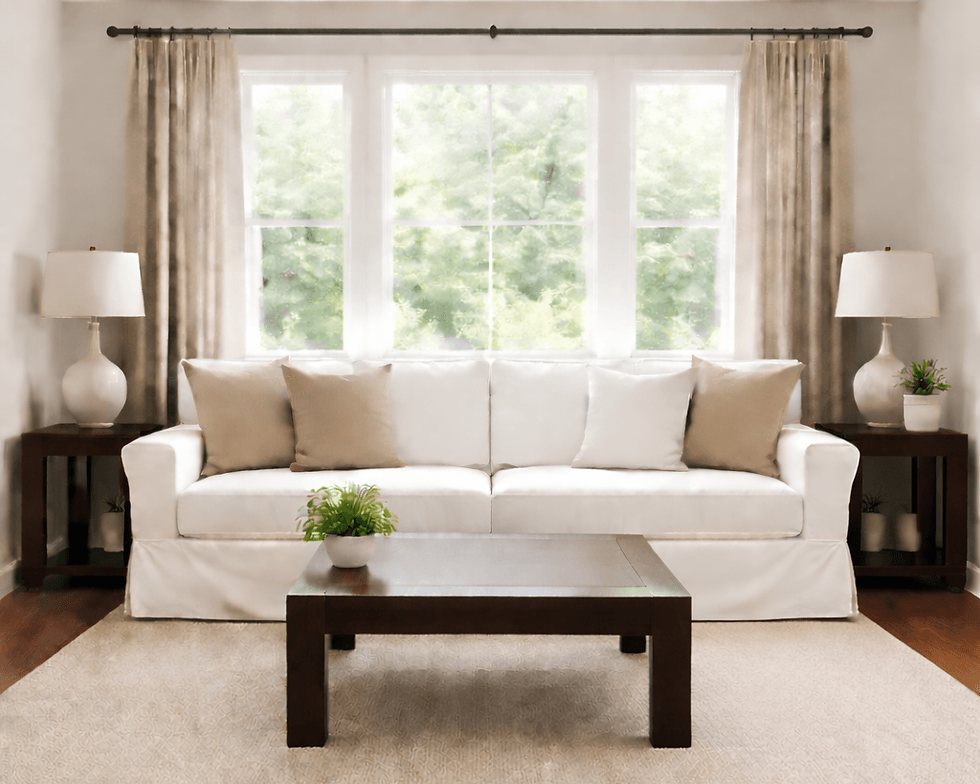

When you understand the language of design, and how to leverage these elements, you can:
Fix a room that feels “off”
Make small updates that have a big impact
Stop wasting money on things that don’t work
How to Start Using This Today
Pick one room.
Stand in the middle.
Slowly turn in a circle.
Ask yourself:
What feels good here?
What feels off?
Is it too full or too empty?
Is the lighting working?
Do the colors make me feel something?
Does anything feel flat or lifeless?
Don’t think “style.”
Think elements.
That’s where the real fixes are.
Tools That Instantly Improve Any Room
These are tools and small upgrades I’ve personally used (or would happily use) in my own home.
Lighting (Biggest Impact Per Dollar)
Elegant LED floor lamp (LED bulb included)
Robert Abbey Dolly Accent Lamp (I love this lamp so much I bought three of them)
Battery-powered, super-cute wall sconces (no electrician required)
Texture & Warmth
Color Control
I use Benjamin Moore paint almost exclusively in my own projects.
Layout & Space Fixes
Painter’s tape (map furniture layouts on the floor)
Measuring tape (use it—seriously)
Pattern & Personality
Pillow covers (easy swap)
Boho-style area rug (a variety of available sizes makes it easy to coordinate room-to-room)
Like Little Green Home?
Subscribe to get new posts that help you build a home you love—that loves you back.
Next Up
Learn how to use color in your home:

Comments